
Knowing exactly which direction your home faces , although it may seem like secondary information, is actually essential to understanding how your home behaves throughout the day and year. Knowing which direction each facade faces allows you to make better use of natural light, improve energy efficiency without major interventions, and plan renovations that improve the quality of life inside.
Knowing the orientation also helps you understand why certain spaces are brighter or cooler than others, why a room overheats in summer, or how to ventilate more naturally. In short, it is the starting point for living more consciously.
1. What methods exist for determining orientation?
There are different ways to determine the orientation of a house or plot of land, ranging from homemade methods to precise digital tools.
The simplest and most traditional method is to simply observe the sun's trajectory. Using the cardinal points as a reference, the sun rises in the east and sets in the west. Taking into account the two hemispheres of our planet, although they share this property, they differ in the sun's trajectory and zenith. While in the northern hemisphere the sun reaches its highest point in the south, in the southern hemisphere it reaches its highest point in the north. For example, if the facade of a building in Spain receives sunlight for most of the day, it is probably facing south.
However, observations may vary depending on the time of year, so it is advisable to use more accurate instruments or references such as an analog or digital compass to indicate the direction each facade faces. Another option is to use online maps or geolocation applications (such as Google Maps or cadastral maps), which allow you to locate the property on the ground and rotate the map to see its exact orientation in relation to north.
Furthermore, from a professional point of view, there are specific tools such as solar diagrams, which allow for precise analysis of how the sun affects a plot of land or building throughout the year. These diagrams provide an essential basis for bioclimatic design and the planning of openings, overhangs, or sun protection.
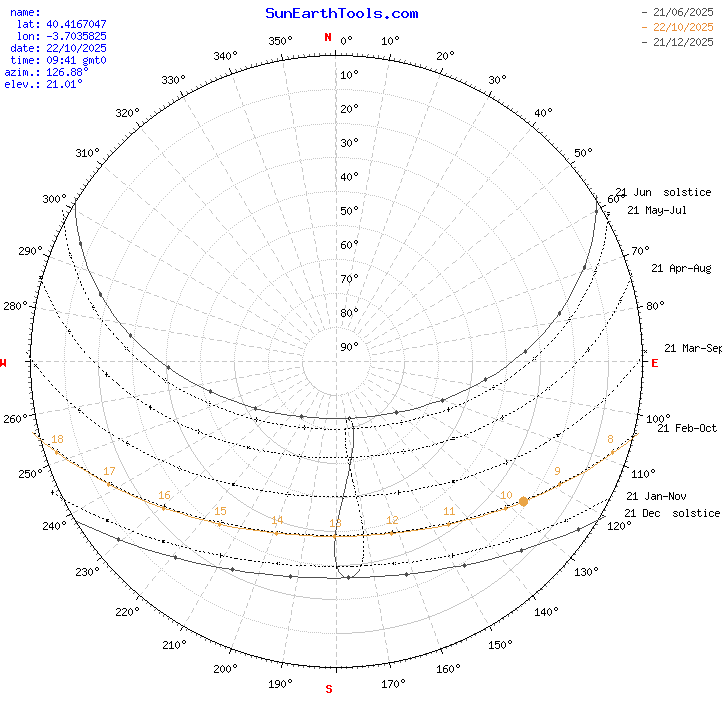
Sunlight diagram, located in Madrid, Spain.
These systems, combined with direct observation of sunlight at different times of the day, provide a clear and practical understanding of the lighting behavior of the home.
2. Interpreting orientation: beyond the cardinal points
However, knowing which direction a house faces is not just about identifying north, south, east, or west, but about interpreting what each one implies. Let's take the northern hemisphere as an example:
- South: this is the most balanced and desirable orientation in temperate climates, as it receives sunlight throughout the day in winter and can be easily protected in summer by eaves or deciduous vegetation.
- East: provides fresh, direct light in the morning, ideal for bedrooms or kitchens.
- West: offers intense afternoon sun, which can be pleasant in winter but excessive in summer if heat gains are not controlled.
- North: provides more constant and diffused light, excellent for studies, workshops, or areas that require uniform lighting without glare.
Understanding these differences allows you to redistribute spaces, plan renovations, or simply use rooms more intelligently: locate living areas in bright areas, use cooler areas for bedrooms, or take advantage of natural shade to improve thermal comfort.
In architecture, knowing the orientation is one of the first steps in the design process. It allows you to decide where to open windows, how to position terraces, and what materials and sun protection to use. But even in existing homes, this knowledge is key to making informed decisions: choosing the right curtains, adding awnings, rearranging furniture, or installing more efficient air conditioning systems.
Ultimately, orientation is not imposed: it is discovered and exploited. Knowing which way a house faces is a way of understanding its dialogue with its surroundings, with the sun, the wind, and the seasons.
At Cabana, we believe that every home has a unique relationship with its orientation and surroundings. Our work starts from that observation: reading how light falls, how air circulates, and how the landscape behaves. Only then is it possible to create homes that do not depend on technology to be comfortable, but rather take advantage of what the place already offers. Understanding orientation is, therefore, the first step toward a more natural, conscious, and living architecture.
Author
Cabana Team
Author information