
Determining how many square meters a house should have is one of the most common questions when starting a project, and also one of the most complex to answer. There is no universal figure: the ideal surface area is not defined solely by the number of rooms or the size of the plot, but by the way of life, the needs of those who live there, and the capacity of the space to adapt over time.
In architecture, square meters are just a starting point. What really matters is how they are organized, how they are perceived, and how they are used. A well-designed home can offer spaciousness and comfort with a limited surface area, while another, twice the size, can be rigid or inefficient.
1. Function, scale, and comfort
The right amount of space is directly related to function and family or personal scale. A young couple may prioritize open, multipurpose spaces over individual rooms; a family with children, on the other hand, will need areas for independence and storage. Lifestyle also plays a role: someone who spends most of the day away from home does not need the same amount of space as someone who works from home.
Therefore, rather than thinking about square footage, it is better to think about uses: what activities take place in the home, how many people live there, and how their needs will evolve. Flexibility becomes an essential quality. Spaces that can be transformed, such as a study that becomes a bedroom or a terrace that is integrated in winter, multiply the functional value of the home without the need to increase the built area.
In this way, the comfort of a home does not depend so much on its square footage as on how it is used. Good orientation, cross ventilation, and natural light can make a small house more livable than a large, poorly designed one. Eliminating empty space and enhancing intermediate spaces such as patios or porches can increase the perception of space without wasting square footage and maintaining visual balance.
2. Guiding and regulatory criteria for surface area
Before establishing some indicative figures, it is necessary to see what limits are set by the regulations. These limits may depend on each local council, autonomous community, or the state through urban planning schemes depending on the type of housing or land. For example, in Madrid, the minimum usable area (minimum interior and habitable space of a dwelling, which is the space that can be walked through without counting vertical elements, common areas, or terraces and balconies) is 40m².
For single-family homes, standards tend to be around 80 m² for small families, between 80 and 130 m² for larger households or homes with additional spaces such as a study or guest room, and large homes starting at 130 m². However, these figures should not be understood as fixed rules, but rather as starting points. The essential thing is that every square meter is well used, that there is consistency between the program, the budget, and the environment, and that the space breathes.
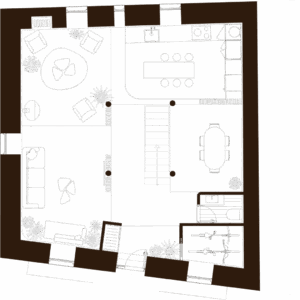
Vesper House. Rascafría, Spain. Ground floor
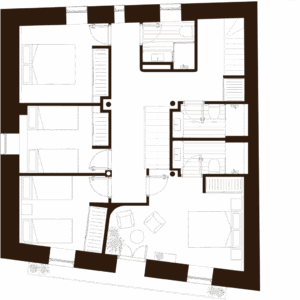
Vesper House. Rascafría, Spain. Upper Floor
Designing a house is not about filling a floor plan with square meters, but rather shaping a way of life. A modestly sized home can offer the highest quality if each space has a purpose and if the relationship with light, views, and nature is well resolved. True luxury in contemporary architecture does not lie in the number of square meters, but in the intelligence of the design: in how functionality, proportion, and atmosphere are integrated.
At Cabana, we believe that every home should find its own measure: one that responds honestly to the lives of those who inhabit it. Our job is to translate those needs into balanced, bright, and coherent spaces, where every square foot makes sense and every decision adds value. Beyond surface area, we seek to ensure that homes convey calm, belonging, and beauty; that they are designed to last, adapt, and be enjoyed to the fullest.
Author
Cabana Team
Author information