

For years, brutalism was the awkward relative of modern architecture: too raw, too heavy, too gray. Its bold geometry and stark materiality became synonymous with institutional rigidity and urban coldness. However, time, with its ability to redefine forms, has restored concrete to its place as a poetic language. Today, a new generation of architects is rediscovering in brutalism not brutality, but the restrained beauty of the essential.
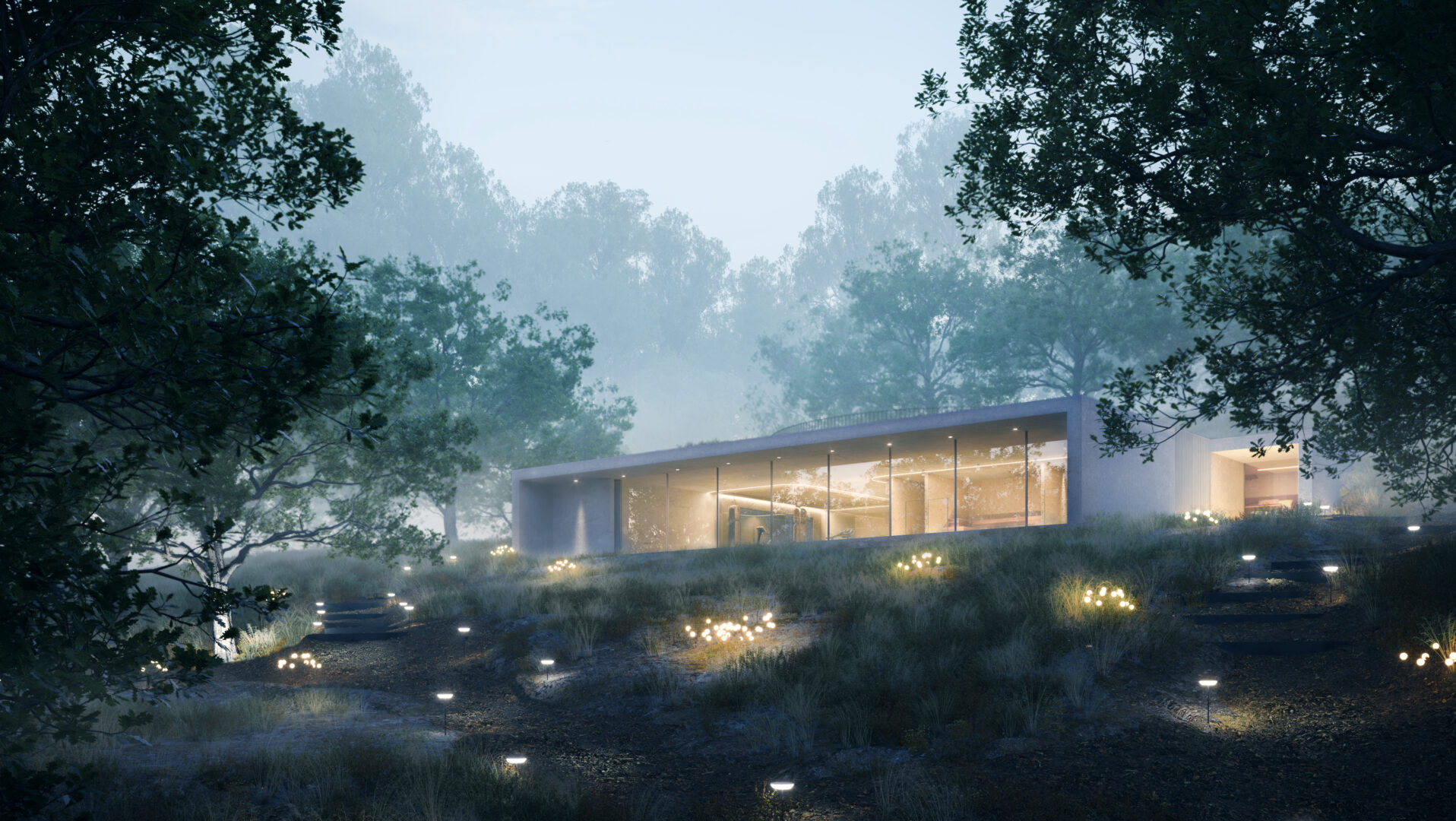
In this renaissance, concrete ceases to be a mute surface and becomes a canvas of light. Its texture no longer seeks to impose, but to reveal. Instead of monolithic facades, we see planes that breathe; volumes that filter the sun with the precision of a lattice; interiors where gray becomes warm, almost velvety. Contemporary brutalism does not shout: it whispers. And in that low tone lies its elegance.
1. The soul of the material
Concrete has always been somewhat contradictory. It is solid yet ductile, heavy yet malleable. In sensitive hands, it is transformed into a noble material that captures light in unexpected ways. The architects of this new movement, such as Tadao Ando and other young European and Latin American studios, have understood that its power lies not in its mass, but in the emotion conveyed by its surface.
Tadao Ando, for example, speaks of concrete as a container of silence. In his Church of Light in Osaka, the purity of the material is sublimated in a gesture: an open cross that lets in the light of dawn. This contrast between density and transparency sums up the new brutalist sensibility. It is not a question of imposing forms, but of constructing atmospheres where space is lived, not just contemplated.
In recent homes, museums, and pavilions, concrete appears polished, nuanced, perforated, even dyed. Its tactility is multiplied by natural light, the wall becomes a screen of shadows, and the material that was once a symbol of hardness is humanized.
2. The poetics of weight
Mid-20th century brutalism emerged as an ethical and aesthetic reaction. Derived from the search for structural sincerity, showing the structure rather than hiding it, its name comes from the French word brut (raw). The buildings of Le Corbusier, Alison and Peter Smithson, and Paul Rudolph spoke of an era that believed in the power of the collective. Today, its reinterpretation has another nuance: it no longer seeks to impose order, but rather to recover an authenticity lost in overly digital or decorative architecture.
In a world saturated with perfect surfaces and prefabricated materials, exposed concrete offers a tangible truth. Each formwork leaves a mark, each joint tells the story of the construction process. This controlled imperfection has become desirable: it connects with a wabi-sabi aesthetic that celebrates the unfinished, the imperfect, the real.
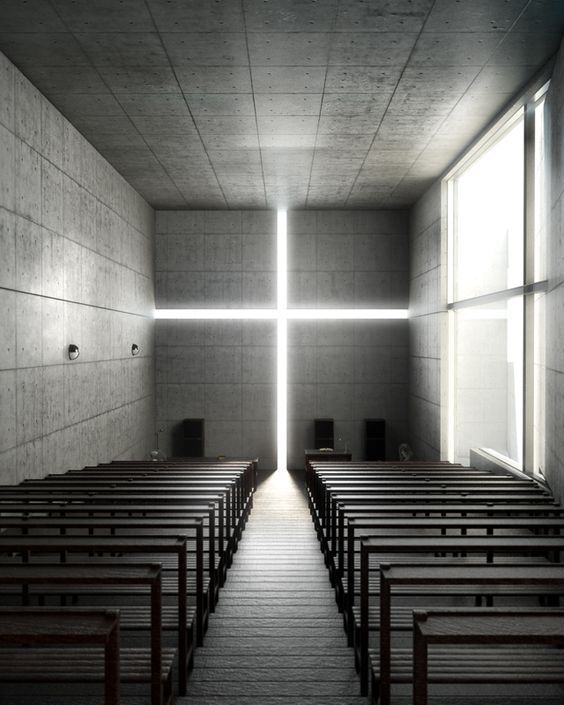
Church of Light – Osaka, Japan. Tadao Ando
3. The sophistication of the essential
The new brutalist elegance stems precisely from this tension between roughness and refinement. Homes that embrace this language do not seek to dazzle, but rather to envelop. Spacious rooms, exposed concrete walls combined with wood, steel, and stone; a neutral palette that allows light to be the true ornament.
The result is a quiet architecture, yet one with a powerful presence. Every line is measured, every opening is designed to allow the sun to shine in at just the right moment. Sobriety becomes luxury. And concrete, once a symbol of uniformity, is transformed into the material of contemporary sophistication.
Brutalism has returned, not as a trend, but as an attitude. In an era that seeks authenticity and meaning, its sober and honest language offers a refuge from artifice.
So-called elegant brutalism is a reconciliation between harshness and sensitivity, between technique and emotion. In its apparent severity lies a luminous beauty: where concrete opens up to light, matter finds its soul.