
Contemporary Arab architecture cannot be understood without considering the extreme climate that surrounds it. High temperatures, intense solar radiation, water scarcity, and extreme temperature contrasts have historically been essential determinants of the built environment in the Middle East. Far from disappearing with modernization, these factors have returned to the center of the architectural debate, driving a sophisticated reinterpretation of ancient solutions through contemporary technology and design.
1. Climate as origin: traditional constructive wisdom
Over centuries, vernacular Arab architecture developed specific responses to a hostile environment. Interior courtyards, solid walls, lattices, wind towers ("barjeel") and narrow streets were not aesthetic choices, but climatic strategies designed to reduce temperature, promote cross ventilation and provide protection from the sun.
These principles remain a conceptual reference today. Modern Arab architecture does not start from scratch: it reinterprets this legacy and adapts it to new scales, programs, and technologies, maintaining a direct relationship between climate and architectural form.
2. From courtyard to atrium: new climatic typologies
In contemporary architecture, the traditional courtyard is transformed into large atriums, central voids, and intermediate spaces that regulate the interior microclimate. These elements act as thermal lungs, reducing dependence on mechanical systems and creating smooth transitions between interior and exterior.
Institutional buildings, museums, and residential complexes incorporate these climatic voids as key elements of the project, combining them with vegetation, water features, and passive solar control to improve comfort in extreme environments.
3. Smart facades facing the desert sun
The architectural envelope takes center stage in arid climates. Deep facades, double skins, dynamic shading systems, and contemporary reinterpretations of the "mashrabiya" allow light to be filtered, reduce heat gain, and create shadow effects that enrich the formal expression of the building.
Far from being mere technical resources, these solutions become a recognizable visual language: architecture that dialogues with the sun, controls it, and integrates it as an essential part of its identity.
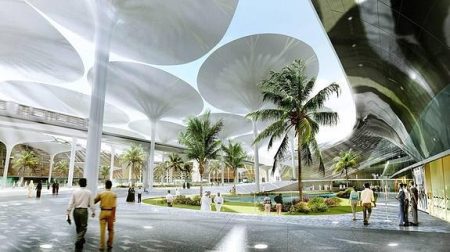
Masdar City – Abu Dhabi, United Arab Emirates. Foster + Partners
4. Skyscrapers adapted to extreme weather conditions
The rise of skyscrapers in Gulf cities has forced a rethinking of international tower models. Orientation, aerodynamics, sun protection, and energy efficiency are studied in detail to respond to sand-laden winds, high temperatures, and strong radiation.
The most advanced towers incorporate compact cores, facades modulated according to orientation, and integrated shading systems that reduce thermal load, demonstrating that even high-rise architecture can adapt to local climatic conditions without sacrificing formal innovation.
5. Technology, sustainability, and the urban future
Modern Arab architecture increasingly relies on climate simulations, high-performance materials, and advanced energy management systems. The goal is not only to withstand the climate, but to turn it into an ally of sustainable design.
Today, comprehensive urban projects are conceived as controlled climate ecosystems, where orientation, density, public space, and architecture work together to reduce environmental impact and improve livability in traditionally challenging regions.
From the desert to skyscrapers, contemporary Arab architecture demonstrates that climate is not a limitation, but rather a generator of form, identity, and meaning. By combining traditional wisdom, advanced technology, and architectural ambition, the Middle East is building its own model, deeply rooted in its context and, at the same time, projected toward the future.
Author
Cabana Team
Author information