
Southern Europe is experiencing a period of particular architectural intensity. In enclaves such as the Spanish Mediterranean coast, the south of France, Italy, and Greece, minimalist villas have established themselves as one of the most sought-after residential types. Far from being merely a response to an aesthetic trend, this boom reflects a profound change in the way luxury is understood: less ostentation, more calm; less artifice, more connection with the environment.
These villas do not seek to impose themselves on the landscape, but rather to engage in dialogue with it. Their architecture is defined by formal restraint, precision in construction, and a careful selection of materials that enhance the spatial and sensory experience of living.
1. Minimalism adapted to the Mediterranean
Unlike Nordic or Japanese minimalism, Southern European minimalism is built around light, climate, and outdoor living. White or mineral-toned volumes, clean lines, and pure geometries are combined with patios, porches, and large terraces that blur the boundaries between indoors and outdoors.
The architecture opens up to the landscape: to the sea, the hills, the olive groves, and the native vegetation. Large glass openings, hidden sliding doors, and integrated shading solutions allow for control of solar radiation without sacrificing the characteristic brightness of the Mediterranean.
2. Honest materials and restrained color palettes
The success of these villas also lies in their materiality. Exposed concrete, natural stone, treated wood for exteriors, microcements, and mineral plasters make up sober and timeless palettes. It is not a question of displaying luxury materials, but of using them judiciously, allowing their texture, aging, and behavior in the light to take center stage.
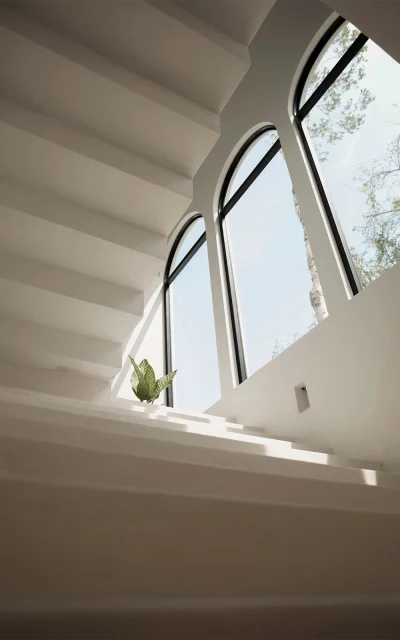
Can Ros – Ibiza, Spain.
The interiors tend to favor material continuity, with floors that extend outdoors and neutral finishes that reinforce the feeling of calm. The architecture thus becomes a silent backdrop that enhances the landscape and everyday life.
3. Villas as contemporary retreats
These homes respond to a new idea of shelter. Spacious but not excessive spaces, clear layouts, visually connected rooms, and a constant relationship with the outdoors define a more conscious and leisurely way of living.
Privacy is managed through the architecture: blind walls facing the street, interior courtyards, varying heights, and carefully designed pathways. The result is homes that are both introspective and open, offering seclusion without losing connection to the surroundings.
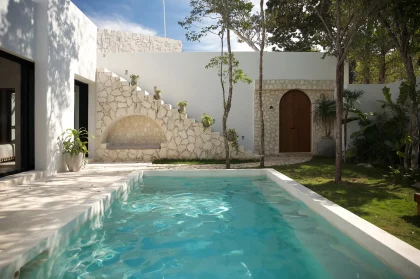
Can Ros – Ibiza, Spain.
4. Integrated sustainability, not declarative
Another pillar of the rise of minimalist villas is the natural integration of sustainable criteria. Proper orientation, thermal inertia, cross ventilation, and passive systems are part of the design from the outset, not as afterthoughts.
Sustainability is understood as a logical consequence of well-designed architecture: lower energy consumption, greater durability of materials, and reduced visual impact on the landscape. In this context, minimalism is not just an aesthetic issue, but a responsible attitude towards the territory.
The rise of minimalist villas in southern Europe reflects a clear evolution in high-end residential architecture. A more serene architecture, more connected to the place and more focused on the experience of living than on image. These homes do not seek to attract attention, but rather to endure, integrate, and offer a way of life aligned with the rhythm of the Mediterranean landscape.
At Cabana, we understand this type of architecture as a synthesis of precision, sensitivity, and context. Villas that are not only designed to be seen, but to be lived in, where every architectural decision contributes to creating timeless, honest spaces that are deeply connected to their surroundings.
Author
Cabana Team
Author information