

Contemporary materials are no longer limited to protecting surfaces: now they think, adapt, and respond to the environment. Smart coatings have become one of the most powerful tools for optimizing comfort, energy efficiency, and architectural aesthetics without adding construction complexity. A single, well-chosen layer can transform the experience of a space.
1. The silent revolution of active material
Smart coatings are the natural evolution of the quest for more attentive, sustainable, and sensory buildings. They include thermoactive technologies, self-cleaning systems, photocatalytic coatings, thermochromic paints, and advanced acoustic solutions that adjust their behavior according to light, temperature, or humidity. This new generation of materials turns walls into interfaces between users and their environment, capable of improving well-being without the need for visible mechanisms.
2. Thermal comfort: surfaces that regulate the indoor climate
Among the most disruptive developments are coatings that contribute to passive temperature control. Coatings that selectively reflect solar radiation, reducing heating without altering the aesthetics of the façade; others that change color or structure to release accumulated heat; and even thermoregulatory microcapsules that absorb and release energy, stabilizing interior comfort. All these innovative examples, when properly applied, result in spaces that are cooler in summer, more stable in winter, and with lower energy demand.
3. Air purification and self-healing: the façade as an active filter
Photocatalytic coatings transform facades into decontaminating systems capable of breaking down nitrogen oxides and volatile organic compounds. Indoors, antibacterial and self-cleaning surfaces reduce maintenance and improve hygiene.
In addition, some advanced coatings incorporate self-repairing properties, allowing any microcracks that may appear to close on their own through chemical reactions activated by light or moisture, extending the material’s useful life and maintaining its impeccable appearance.
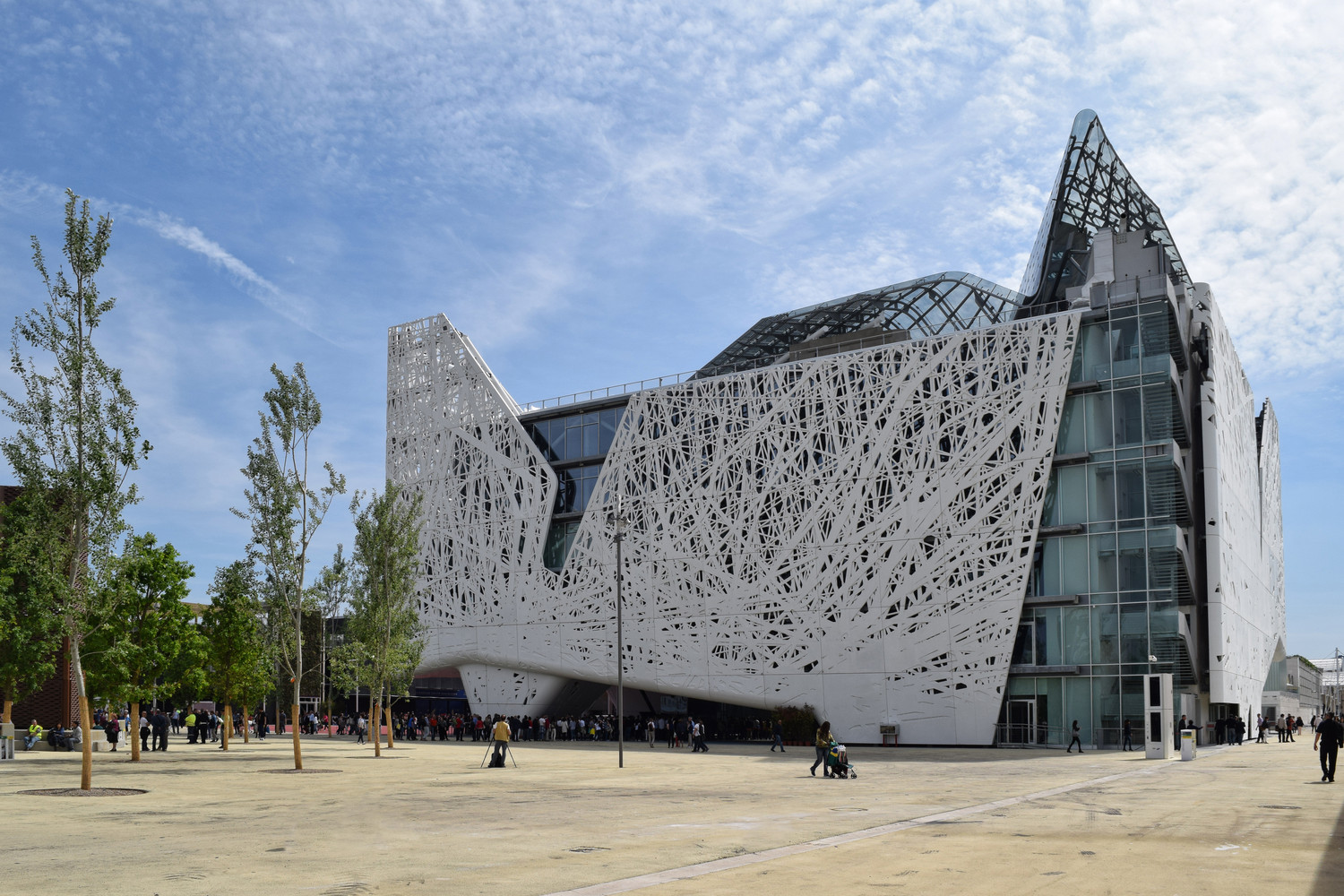
Technology Pavilion at EXPO 2015 – Milan, Italy. Nemesi Architects
It uses photocatalytic cement (TX Active) throughout its skin, which purifies the air and keeps the surface clean by reacting with sunlight.
4. Acoustics, texture, and perception: the sensory experience becomes receptive
The intelligence of the cladding is also expressed in intangible ways. Modular porous materials, variable absorption panels, and sound-active surfaces allow acoustic quality to be controlled without compromising on design.
At the same time, new smart textures incorporate minimal reliefs that redirect airflow, improve diffuse lighting , or intensify tactile warmth. Together, these solutions create calmer, more balanced, and more pleasant atmospheres.
5. Contemporary aesthetics without added complexity
Far from being exclusively technical solutions, smart coatings open up a renewed aesthetic imagination. They can be invisible, enhancing the purity of the design, or become protagonists through subtle effects: color changes, luminous nuances, regulated glows, or textural transitions.
Today’s architecture no longer separates comfort, efficiency, and beauty: it integrates them. Smart cladding shows that the future lies not in adding layers, but in making each one work harder and better. It is a powerful tool for creating adaptive, sustainable, and sensorially rich buildings capable of offering well-being with minimal visible technological intervention. The surface thus becomes an active system that enhances the quality of the space.