
Contemporary architecture has found fertile ground in the Middle East to experiment, scale, and redefine the limits of design. Driven by a unique combination of strategic investment, political will, cultural identity, and climate emergencies, the region has established itself as a laboratory where great technological innovation and the reinterpretation of local heritage coexist. Far from being an isolated phenomenon, this boom responds to a long-term vision that understands architecture as cultural, economic, and symbolic infrastructure.
1. Urban vision and state projects
In the Middle East, architecture is not only the result of private initiatives, but also a central tool for national planning. Megaprojects such as NEOM in Saudi Arabia, Lusail City in Qatar, and Masdar City in Abu Dhabi embody a comprehensive urban ambition: cities designed from scratch, with clear objectives in terms of sustainability, mobility, and quality of life.
These initiatives allow architects to work with scales and budgets that are unusual in other contexts, favoring radical solutions and unprecedented typologies. Architecture thus becomes an instrument of global positioning and economic diversification, especially in economies traditionally dependent on hydrocarbons.
2. Iconic architecture as a cultural strategy
Museums, cultural centers, and public facilities have played a key role in the region's international projection. Buildings such as the Louvre Abu Dhabi, the National Museum of Qatar, and the Dubai Opera stand out not only for their formal power but also for their ability to construct narratives.
Far from being empty icons, many of these projects articulate discourses that connect tradition and contemporaneity, landscape and geometry, shadow and monumentality. Architecture is understood as a sensory experience and a vehicle for cultural diplomacy, attracting talent, tourism, and international recognition.
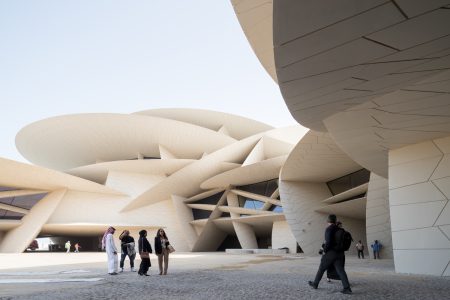
Qatar National Museum, the "compass rose" – Doha, Qatar. Jean Nouvel
3. Extreme weather, advanced solutions
Designing in the Middle East means dealing with demanding climatic conditions: high temperatures, intense solar radiation, and water scarcity. This reality has driven the development of technically sophisticated architecture, where energy efficiency and passive comfort are priorities.
High-performance facades, shading systems inspired by vernacular architecture, natural ventilation reinterpreted through advanced technology, and state-of-the-art materials are part of the usual vocabulary. The result is architecture that not only withstands the environment but also learns from it.
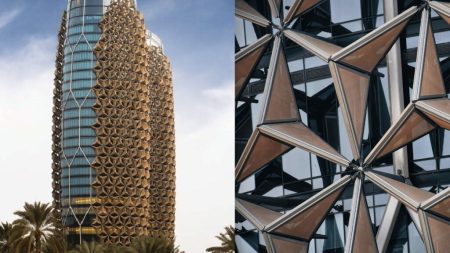
The Al Bahar Towers and their responsive adaptive facade – Abu Dhabi, United Arab Emirates. Aedas Architects
4. Tradition reinterpreted
One of the most interesting features of contemporary architecture in the region is its ability to reinterpret traditional elements without falling into literalism. Courtyards, latticework, Islamic geometries, and the symbolic use of light are translated into contemporary, abstract, and precise languages.
This approach allows identity to be constructed without resorting to nostalgia, creating spaces that are deeply local and, at the same time, universally contemporary. Tradition becomes a system of references, not a formal straitjacket.
5. A magnet for global talent
Large international studios coexist with a new generation of local architects and designers who bring their own perspectives and contextual knowledge to the table. This convergence has created a highly competitive creative ecosystem, where innovation is an expectation, not an exception.
The region acts as a testing ground for new construction technologies, advanced digital processes, and complex structural solutions, consolidating its role as one of the main stages of global architecture today.
The Middle East has ceased to be merely a showcase for spectacular architecture and has become a true center of architectural thought, experimentation, and production. Its ability to combine strategic vision, resources, cultural identity, and climate response places it in a leadership position that is difficult to ignore.
Author
Cabana Team
Author information