
The villa is one of the most highly valued types of residential property in Spain, not only for its aesthetics and level of comfort, but also for the lifestyle it represents. To understand what type of property a villa is, it is useful to analyze its technical definition, its evolution, its variants, and why it continues to be synonymous with exclusivity and privacy.
A villa is a single-family home built on a private plot, usually with a garden, which may be detached or share walls with other similar homes. It represents a type of residential property where privacy, contact with the surroundings, and independence from apartment buildings are paramount.
1. What defines a villa
Although the term has become very popular, its technical use is more specific. In the Spanish urban context, a chalet is a single-family home, built on an individual plot of land and with a layout designed for a single household. Unlike apartment buildings, chalets do not share a vertical structure or access with other homes.
It usually has several floors, normally two or three, and has its own outdoor spaces, such as a garden, patio, terrace, garage, or even a swimming pool. Its structure can be completely detached or partially attached to another, giving rise to variants such as semi-detached or terraced houses.
2. Origin and evolution of the concept
The origin of the term "chalet" comes from the French chalet, which referred to small rural buildings in mountainous areas, especially in the Alps. These buildings were used by shepherds or as summer homes, with sloping roofs to withstand the snow and a clear connection to the natural environment.
Over time, the concept spread to urban and peri-urban areas, becoming synonymous with recreational housing, luxury, or high quality of life. In Spain, during the 1960s and 1970s, many chalets emerged as second homes on the coast or in the mountains, while today they form part of the usual residential stock in many urban developments.
3. Technical and aesthetic characteristics
Although there is no single way to build a villa, there are some common features:
Structural or relative independence: houses can be detached (no shared walls), semi-detached (sharing one side wall), or terraced (sharing two walls).
Garden or outdoor space: whether it's a backyard, a landscaped terrace, or a green area, having your own plot of land is a distinctive feature.
Independent access: no shared entrances, landings, or elevators.
Flexible layout: they usually offer more freedom to design spacious rooms, open areas, double-height ceilings, or integrated garages.
Integration with the surroundings: many chalets are designed to take advantage of views, natural light, or to blend harmoniously with their surroundings.
4. Types according to their configuration
Not all chalets are the same, and it is important to distinguish between their main variants:
Detached house
This is the most classic and exclusive model. It is completely separate from other homes, with its own perimeter and no shared walls. It provides the highest degree of privacy and allows greater freedom in the design of facades and garden layout.
Semi-detached house
They are built in pairs: two homes that share a dividing wall (side wall), but still have separate entrances, gardens, and structures. This is a very common solution in residential developments where a balance between density and comfort is sought.
Semi-detached house
It is part of a row of houses joined on the sides. They usually share two walls and have a narrow garden at the front or back. Although they offer less privacy, they are more affordable and take up less urban land.
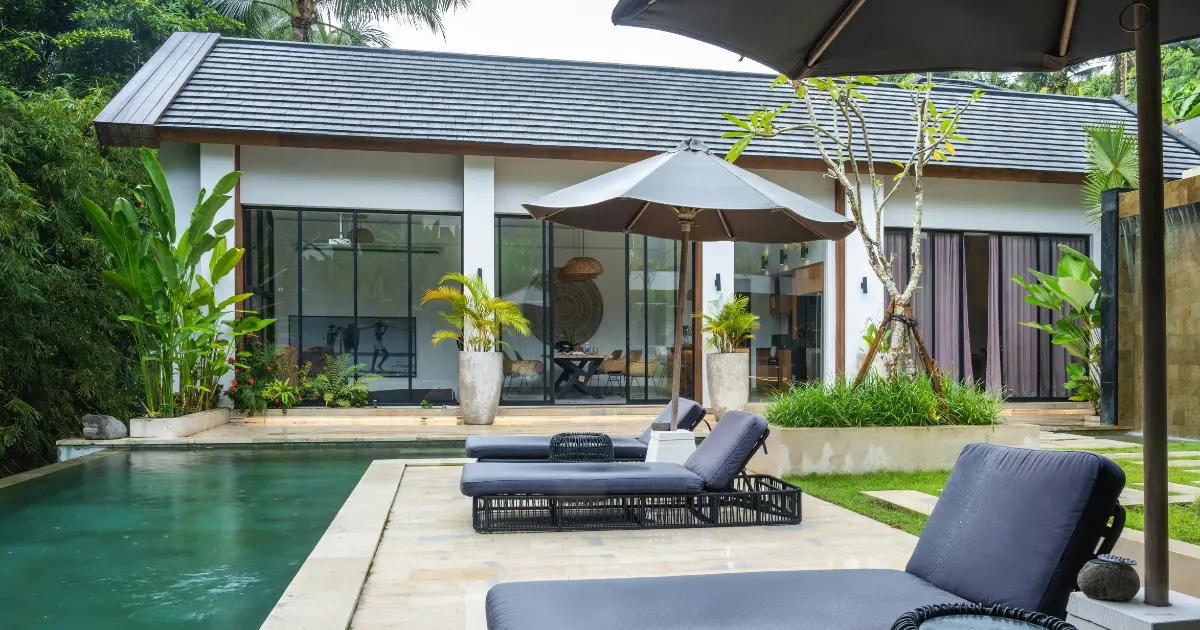
5. Chalet, house, or villa: are they the same thing?
The terms "chalet," "house," and even "villa" are often used interchangeably, but there are subtle differences.
A house is a broad concept that can refer to both a single-family dwelling and a dwelling within a block (as in "apartment building"). The term is generic and does not necessarily imply ownership of land or independence.
The villa, on the other hand, does presuppose a single-family home with a plot of land, as we have seen. It is a specific category within the term "house."
On the other hand, the term villa is often used to refer to single-family homes that are more luxurious, larger, or of a higher architectural standard. It is not a technical urban planning term, but in the real estate market it is used to distinguish premium properties, usually located in exclusive areas.
6. Urban villa vs. country villa
It is also important to differentiate between chalets located in urban or suburban areas and those located in rural or mountainous areas.
Urban villas form part of the residential fabric of a city or municipality, often in planned developments or neighborhoods. They have access to services, transportation, schools, etc.
Country houses are usually located further away, designed as second homes or even permanent residences for those seeking a quieter lifestyle. These houses sometimes have larger plots of land, but may lack some urban infrastructure.
7. Advantages and disadvantages of living in a villa
Choosing a villa means adopting a different lifestyle from that offered by apartment buildings. Its advantages are obvious:
Greater privacy and quiet
Contact with nature
Pets allowed, vegetable garden, swimming pool
Space for large families or teleworking
However, it also entails some additional responsibilities:
Maintenance of gardens, facades, and outdoor areas
Higher initial investment (in most cases)
Isolation if located far from urban centers
Need for a car to get around in many locations
8. Why is it still a desirable model?
Despite urban densification and the rise of high-rise apartments, detached houses remain one of the most desirable types of housing. According to data from Idealista, demand for detached houses increased by more than 30% between 2020 and 2023, driven by remote working, the desire for open spaces, and the need for privacy.
Furthermore, in many areas of the Mediterranean coast, northern Spain, and inland regions (such as Madrid and Zaragoza), the development of residential areas with detached houses continues to be promoted in response to population growth and quality of life.
Author
Cabana Team
Author information