

What is the difference between a retail park and a shopping centre?
The difference between a retail park and a shopping centre lies in their format, the way they are accessed, the type of operators and the shopping experience they offer. Although both concentrate retail activity, they do not follow the same model. One prioritises functionality and direct access; the other tends to focus more on dwell time and an all-round experience.
Why the two concepts get confused
The difference between a retail park and a shopping centre raises questions because both formats bring together shops, services and consumer activity within a single setting. At first glance they may seem equivalent, but in reality they respond to quite different commercial and spatial logics.
The confusion usually stems from the fact that both belong to the retail sector and share the idea of concentrating an offer in a specific location. However, the way they are organised, how they are navigated and what the visitor expects from each one differ clearly.
Understanding this difference is important for users as well as for developers, operators and professionals involved in the design and management of retail spaces.
What a retail park is
To properly understand the difference between a retail park and a shopping centre, it is worth starting by defining the retail park. It is a group of establishments, normally large in size, located in the same developed area and with direct access from outside.
It is usually located in peripheral areas or places that are easy to reach by car. Its configuration is open, with a strong emphasis on parking and vehicle mobility. Rather than relying on a large shared internal mall, each operator usually has its own independent entrance.
This format is designed to make shopping practical, convenient and efficient, especially when the user already knows what they need and wants to get to the relevant unit quickly.
What a shopping centre is
The difference between a retail park and a shopping centre also becomes clearer when a shopping centre is defined. In this case, we are talking about a planned complex that brings together multiple establishments under a common organisation, normally with shared interior areas, defined routes and centralised services.
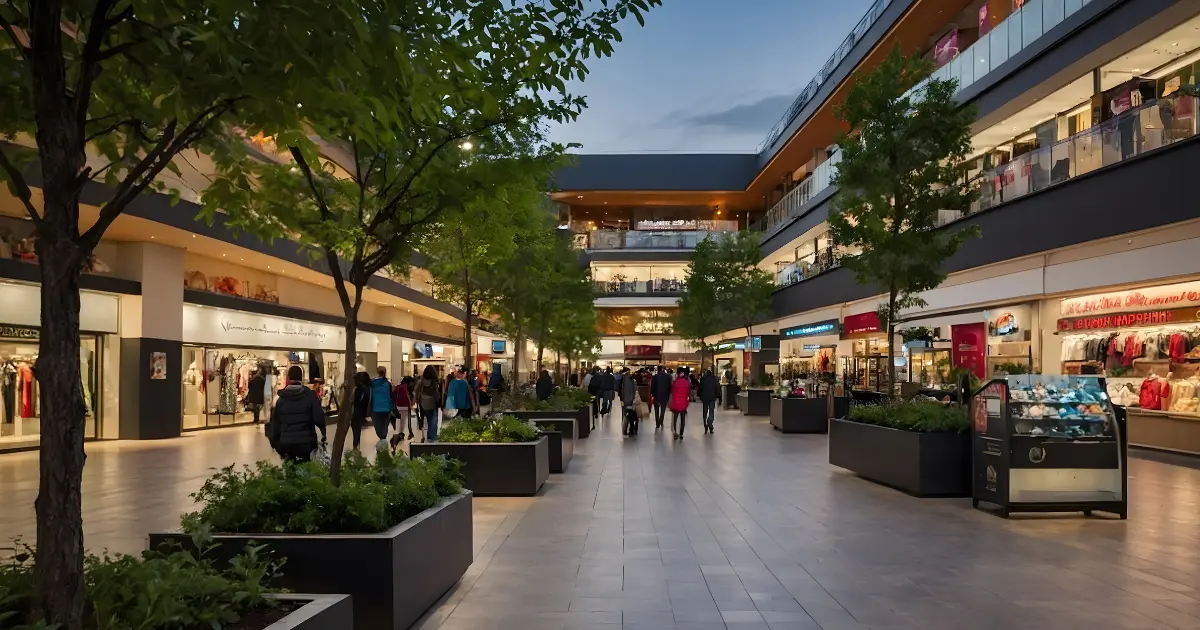
A shopping centre usually combines shops, food and drink, leisure and rest areas in a more integrated experience. It is often developed as an enclosed or semi-enclosed, air-conditioned building designed for visitors to spend more time inside the premises.
Unlike the retail park, here the internal route and the overall experience of the space carry a great deal of weight. The aim is not only for the customer to buy, but to stroll, linger and combine different activities in a single visit.
The main difference lies in the format of the space
The most visible difference between a retail park and a shopping centre is in their physical configuration. A retail park is usually open, with independent units facing outwards and connected by roads, pavements or parking areas. It does not need a large internal mall to function.
A shopping centre, on the other hand, is usually organised around shared interior spaces. The units are arranged along corridors, squares or internal routes designed to connect the whole offer in a more continuous, sheltered experience.
Quick summary of each format
Put simply, it can be understood like this:
- A retail park is usually open-air.
- A shopping centre usually has shared interior routes.
- A retail park prioritises direct access.
- A shopping centre prioritises an integrated experience.
This difference in format shapes the architecture, mobility and use of the space.
Difference in the way they are accessed
Another key to understanding the difference between a retail park and a shopping centre is the way the visitor reaches the establishments. In a retail park, access is usually immediate from the car park or from outside. Users can arrive by car, park close to the unit and walk straight in.
In a shopping centre, access is more centralised. Although there may also be parking, visitors usually enter the complex and then move through its common areas to reach the shops. This makes the route longer and more tied to the experience of strolling.
That is why the retail park is associated more with efficiency and speed, while the shopping centre favours a broader, less linear visit.
Difference in the type of operators
The difference between a retail park and a shopping centre is also apparent in the businesses that typically set up in each. In retail parks it is common to find large specialist stores in homeware, DIY, decoration, sport, electronics, gardening or food.
These operators need spacious units, good external visibility and logistical ease. The format fits very well with planned purchases or larger products.
In shopping centres, the retail mix is usually more diverse. Fashion, food and drink, leisure, personal services, accessories and specialist shops of varying sizes are more common. The variety aims to attract broader profiles and encourage a more complete consumer experience.
Difference in the shopping experience
One of the most important issues in the difference between a retail park and a shopping centre is how the user experiences the visit. In a retail park, the experience is usually more functional. The customer normally arrives with a defined intention, makes their purchase and leaves the premises without needing to walk around much.
In a shopping centre, the experience is geared more towards dwell time. Visitors can come in without a single specific mission, compare options, stroll, eat, go to the cinema or spend part of their free time there. The space is designed to extend the stay and combine several uses in a single visit.
What the customer values in each format
In general terms, users tend to look for:
- In a retail park: speed, easy access and practical shopping.
- In a shopping centre: variety, indoor comfort and a more complete experience.
This difference influences the design, circulation and strategy of each retail asset.
Difference in typical location
The difference between a retail park and a shopping centre is also related to location. Retail parks are usually built in peripheral areas, where more land is available and it is easier to organise vehicle access and large car parks.
A shopping centre can be on the outskirts or in more established urban areas, depending on its size and the model of the city. In any case, its siting logic does not depend so much on direct access to each shop as on the ability to draw footfall towards a complex managed as a single whole.
This difference in location has clear consequences for user behaviour and for the selection of operators.
Difference in the role of leisure and food and drink
When analysing the difference between a retail park and a shopping centre, a clear separation also emerges in the weight given to leisure and food and drink. In a shopping centre, these elements are usually an essential part of the offer. They are not a minor add-on but a tool for increasing dwell time and enriching the visit.
In a retail park there may be cafés or restaurants, but they normally play a complementary role. The main focus remains functional shopping and quick access to specific operators. Leisure, where it exists, does not usually structure the project with the same intensity.
This nuance explains why the shopping centre is usually perceived as a more experiential destination.
Difference in circulation and route design
The difference between a retail park and a shopping centre is also reflected in how the visitor moves around the space. In a retail park, circulation usually depends heavily on the vehicle and on outdoor routes. The user arrives, parks, enters the unit and repeats that pattern if visiting several establishments.
In a shopping centre, the internal route plays a leading role. The architecture is designed to guide visitors through different areas, encourage the discovery of shops and generate a more connected experience. The common areas do not just link units; they are also part of the asset’s value.
This logic influences the signage, the design and the commercial performance of the whole complex.
Which format is more functional depending on the objective
The difference between a retail park and a shopping centre does not mean that one is better than the other in absolute terms. Everything depends on the use, the context and the type of retail activity to be promoted.
A retail park is especially effective when the aim is car accessibility, quick shopping, large operators and an open layout. A shopping centre, on the other hand, works very well when the objective is to create a place to spend time, a mix of uses and a more complete experience for different visitor profiles.
When each one tends to fit best
In general:
- A retail park is a better fit for planned, functional shopping.
- A shopping centre is a better fit for broader consumer experiences.
That is why both formats can be highly competitive if they respond to the right context and a well-defined strategy.
How this difference affects the value of the asset
The difference between a retail park and a shopping centre also has implications for investment, management and positioning. A retail park tends to rely more on external visibility, vehicle access and the strength of large-format anchor operators.
A shopping centre, for its part, requires more intensive management of the overall experience, the retail mix, the common areas and the activation of the space. Its value depends heavily on how the complex performs as a destination, not just on each unit in isolation.
In summary: what is the difference between a retail park and a shopping centre
The difference between a retail park and a shopping centre is based on format, access, type of operators and user experience. The retail park is more open, functional and geared towards practical shopping with direct access from outside. The shopping centre is usually more integrated, inward-facing and designed to combine shopping, leisure, food and drink and dwell time.
Understanding this difference makes it easier to assess what each model offers and why both still make sense in today’s retail landscape. Although they share the concentration of an offer in a single setting, their spatial and commercial logic is clearly different.
A retail park usually requires an architectural design geared towards vehicle accessibility, external visibility of the units and logistical ease. Car park planning, road access and the organisation of large retail units are key aspects in this type of project. Retail parks need large plots of land and convenient vehicle access. For this reason they are usually located in peripheral areas or expanding commercial zones, where it is easier to provide extensive parking areas and large-format units. Retail parks usually work better for businesses that need large floor areas or direct access for transporting bulky products, such as homeware or DIY stores. Shopping centres, on the other hand, are more suitable for fashion, leisure or food and drink brands that depend on a constant flow of visitors and a longer shopping experience.Frequently Asked Questions
What type of architectural project does a retail park require?
Why are retail parks usually located on the outskirts of cities?
Which retail format is most suitable depending on the type of business?