
Shopping centers are classified based on criteria such as their size, catchment area, retail offerings, location type, and role within the urban environment. This classification provides a better understanding of how they are designed, the target audience they serve, and the role they play in the economic and social life of an area.
Why is it important to classify shopping centers?
Classifying shopping centers is not just a technical matter. It also helps developers, brands, investors, and consumers understand what kind of space they are dealing with and what they can expect from it.
Not all shopping centers operate on the same principle. Some are designed to meet the neighborhood’s everyday needs, while others aim to attract visitors from various cities with a much wider range of offerings. For this reason, the classification allows us to distinguish between formats, sizes, services, and appeal.
In addition, this segmentation facilitates urban planning, the selection of operators, and the development of business strategies tailored to each model.
Classification of shopping centers by size
One of the most common criteria for classifying shopping centers is their size. Size directly influences the variety of stores, the range of leisure activities, the average length of a visit, and the size of the target audience.
Generally speaking, several categories are typically distinguished:
Small shopping centers.
Medium-sized shopping centers.
Large shopping malls.
Mega-centers or regional complexes.
Smaller centers typically have a limited selection and a practical focus. Larger centers, on the other hand, combine retail, dining, entertainment, and services in a single location, offering a much more comprehensive experience.
The classification of a shopping center determines its design, its strategy, and the user experience.
At Estudio Cabana, we specialize in commercial space design in Madrid.
Classification by catchment area
Another key factor is the catchment area from which they attract visitors. Not all shopping centers compete on the same scale, and their catchment area provides a better understanding of their role in the market.
Community centers
They are aimed at people who live or work nearby. They cater to everyday and convenience needs, with supermarkets, basic services, affordable fashion, and fast food.
Local centers
They attract customers from one or more neighborhoods within the same city. They typically offer a wider range of retail options and a more comprehensive shopping experience than a neighborhood store.
Regional centers
They have the ability to attract visitors from various municipalities or even from an entire province. They feature popular brands, movie theaters, family entertainment, and a wider range of dining options.
Destination centers
These spaces are designed to stand out on their own. Beyond just shopping, they invite visitors to spend several hours there thanks to their unique offerings.
Types of shopping centers based on their retail offerings
The mix of tenants is also used to classify shopping centers. In this case, what matters is not just the number of stores, but the types of retailers that make up the space and the needs they serve.
Some models rely on everyday purchases, while others rely on occasional or experiential purchases. Among the most common formats are:
Convenience-focused stores.
Shopping centers with a strong focus on fashion and accessories.
Stores specializing in home goods, home decor, or DIY.
Centers offering a mix of retail, leisure, and dining options.
Outlet centers focused on price and value.
This classification is important because it influences both the visitor profile and the frequency of visits, as well as the expected average spend.
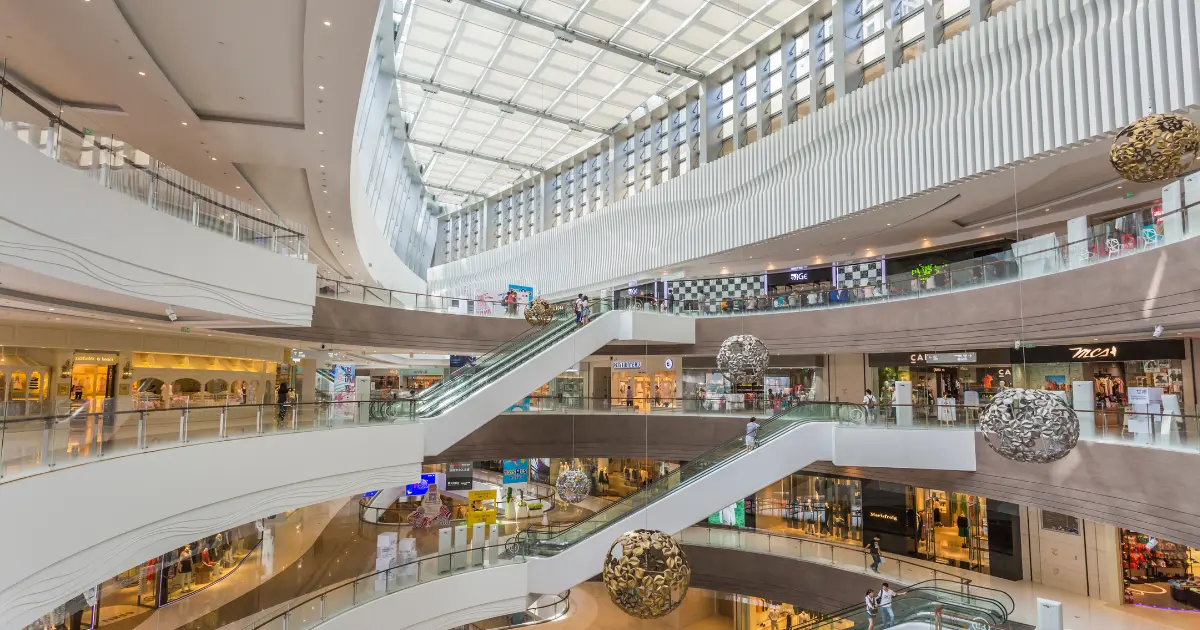
Shopping centers by location
The physical location also makes a big difference. A facility does not operate the same way if it is located in the heart of the city as it does if it is situated on the outskirts, where access is primarily by car.
Urban centers
They blend into the cityscape and typically benefit from a steady flow of foot traffic. They usually have more direct access to public transportation and are more closely integrated into the daily life of the surrounding area.
Peripheral centers
They are located outside the city center and usually require special transportation arrangements. In return, they offer more space, ample parking, and the capacity to accommodate large operators.
Facilities integrated into mobility hubs
Some formats are located in stations, transit hubs, or high-traffic areas. Their business model is closely tied to convenience and speed of purchase.
Classification by function and user experience
Shopping centers can also be classified based on their primary function for visitors. This approach is useful because it focuses on the experience rather than just the physical structure of the property.
In this context, we can identify institutions focused on:
Quick and convenient shopping.
Family outings and leisure activities.
Dining experiences.
Entertainment and extended stay.
Specialty shopping.
A convenience-focused store aims to meet customers' needs quickly. In contrast, an experience-oriented store seeks to encourage customers to stay longer, foster interaction, and become a gathering place.
How shopping centers are classified based on their design
Architectural design and spatial layout are other factors that influence the classification. Although this criterion is sometimes overlooked, it directly affects circulation, the visibility of premises, and the user experience.
Some of the most common settings include:
Enclosed facilities with climate-controlled indoor circulation.
Open-concept spaces with outdoor walkways.
Mixed-use facilities that combine indoor and outdoor spaces.
Outlet malls, featuring large retail spaces and direct access to each store.
Each type is designed to meet specific needs. Closed centers typically offer greater environmental control and a more uniform experience. Open centers, on the other hand, can blend in better with certain environments and provide a more flexible feel.
Difference between a shopping mall and a retail park
Although they are often used interchangeably, they are not always equivalent. A shopping center is typically organized as a planned complex with common areas, centralized management, and a mix of retail tenants designed to create synergies among operators.
Retail parks, on the other hand, typically bring together medium-sized or large stores with more independent access. The shopping experience there is less integrated and more functional, especially in categories such as home goods, automotive, electronics, and equipment.
This difference is important because it affects the asset's classification, the business strategy, and the type of visitors it attracts.
Factors that determine the actual ranking
Although there are standard categories, the actual classification of a shopping center usually depends on a combination of factors. It is not enough to consider only the floor area or the location.
Factors such as the following are typically taken into account:
Gross leasable area.
Number and type of operators.
Presence of commercial locomotives.
Effective coverage area.
Additional services.
The importance of leisure and dining.
Accessibility and connectivity.
For this reason, two complexes of similar size may be classified differently if their business model, appeal, or visitor experience are not equivalent.
Todo ello forma parte de la arquitectura corporativa y comercial que desarrollamos.
Common mistakes when talking about shopping malls
One of the most common misconceptions is that all shopping centers are large spaces designed for leisure. In reality, many are designed to meet local needs and have a much more practical approach.
Another common mistake is to evaluate them based solely on visual appearance. Just because a facility looks large doesn’t mean it has the same regional reach as another one with a better program, better accessibility, or greater appeal.
Concepts such as shopping arcades, retail parks, and shopping malls are also often confused, even though each follows a distinct approach to design, management, and use.
Conclusion
Understanding how shopping centers are classified provides a better basis for analyzing their role, scope, and value proposition. There is no single way to categorize them, as they can be segmented by size, location, catchment area, retail offerings, design, and type of experience.
Shopping centers come in a wide variety of formats, and classifying them helps explain why some focus on everyday convenience while others aim to become destinations for shopping and leisure. The better we understand these differences, the easier it is to assess their role within the market and the urban environment.
Frequently Asked Questions
What factors influence the architectural design of a shopping center?
The design of a shopping center depends on factors such as available floor space, the number of stores, the presence of major retailers, accessibility, and expected foot traffic. A well-planned project must organize circulation, common areas, and entrances to enhance the customer experience and maximize store visibility.
Why is it important to plan a shopping center carefully from an urban planning perspective?
Urban planning determines how a shopping center relates to its surroundings, access from the city, mobility, and integration with other services. A well-designed approach improves accessibility, attracts more visitors, and has a positive impact on economic activity in the surrounding area.
How does architecture influence the shopping mall experience?
Architecture determines how people move through a space, which areas attract the most attention, and how long visitors stay. Factors such as the layout of hallways, lighting, rest areas, and connections between floors directly influence the user experience.
Are you developing a shopping center?
Author
Cabana Team
Author information