

Contemporary architecture is undergoing a period of rapid transition. As cities seek more sustainable and efficient models, research into new materials is opening up avenues that seemed like science fiction just a decade ago. It is no longer just a question of building better, but of building in a smarter, more sensitive, and more responsible way. In this new scenario, materials are emerging as silent protagonists capable of transforming the spatial experience, the durability of buildings, and the environmental impact of each project.
Today, the conversation no longer revolves around brick, steel, and concrete as absolutes, but rather around their technological reinterpretations and new composites that promise to change the rules of the game. From self-repairing bio-concretes to energy-regulating glass and modified woods that double their strength, material innovation is redefining the image and performance of 21st-century architecture.
1. Biotechnology at the service of construction
One of the most disruptive advances is the development of living or bioactive materials. Bio-concrete, capable of sealing small cracks by itself thanks to its encapsulated bacteria, can drastically reduce maintenance costs and extend the life of various concrete elements. In turn, biopolymers derived from algae or agricultural waste are beginning to replace plastics and synthetic resins, generating lighter and completely biodegradable solutions. These types of materials open the door to buildings that behave almost like organisms: they consume less, regenerate themselves, and minimize their ecological footprint.
2. Advanced woodworking: tradition and technology
Wood, one of the oldest building materials, is undergoing its own revolution. CLT and LVL, along with other thermally modified wood variants, allow high-rise buildings to be constructed with a much lower carbon footprint than concrete and steel. Its structural performance, combined with its warmth and natural moisture regulation capacity, is driving a new aesthetic of sustainable verticality.
3. Smart ceramics and active surfaces
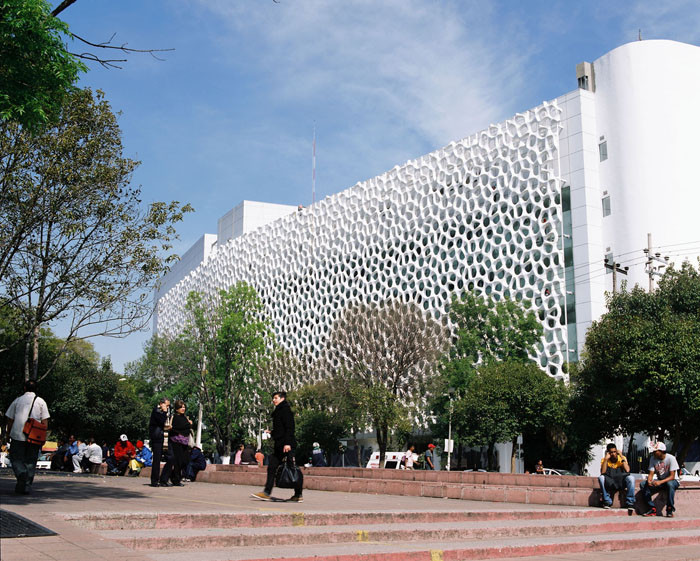
In recent years, photocatalytic ceramics capable of decontaminating the air have emerged, as well as pavements that convert pedestrian traffic into energy and digitally printed ceramic panels that allow facades to be customized with millimeter precision. Ceramics, far from their traditional connotation, have become a first-rate technical and aesthetic ally for projects that seek performance without sacrificing expressiveness.
New façade of the Dr. Manuel Gea González General Hospital – Mexico City, Mexico. Elegant Embellishments.
The façade, made from a new type of ceramic, absorbs and neutralizes air pollution from the surrounding area.
4. State-of-the-art glass: transparency that thinks
Smart glass is another major driver of change. Electrochromic solutions allow opacity to be adjusted according to light and heat, significantly reducing energy consumption. Added to this is the arrival of ultra-lightweight glass, photovoltaic glass that integrates renewable energy into the building envelope, and high-strength panels that enable slimmer and brighter extensions.
5. Reinvented concrete
Far from disappearing, new ultra-high performance concrete (UHPC), recycled fiber composites, and low-emission cements are becoming more efficient, lightweight, and sustainable alternatives. Their malleability and strength allow for increasingly radical forms without compromising stability or environmental impact, promoting a more fluid and experimental architectural language.
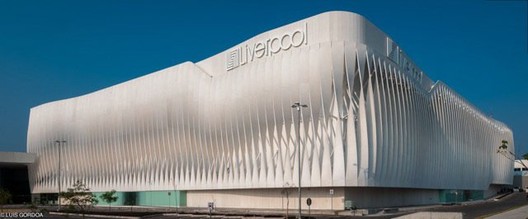
Liverpool Store – Tabasco, Mexico. Iñaki Echeverria.
UHPC facade.
Innovation in materials is not a separate chapter within contemporary architecture: it is probably its most silent and decisive driving force. The choice of materials defines how a building ages, how much energy it consumes, how it interacts with its context, and what emotions it arouses in those who inhabit it. The architecture of the future will depend not only on design talent, but also on the ability to integrate materials capable of responding to the environmental, technological, and social challenges of our time.
At Cabana, we work precisely from this conviction: understanding materials as the conceptual, expressive, and sustainable basis of each project. Exploring their possibilities means expanding the potential of architecture, anticipating what is to come, and designing with a truly contemporary vision.