

What are the main types of office?
The main types of office reflect different ways of working, organising teams and making the most of space. From closed offices to open-plan, hybrid or flexible models, each format offers specific advantages depending on the company’s activity, its internal culture and its needs in terms of productivity, privacy and collaboration.
What is meant by types of office
When we talk about the main types of office, we are referring to the different ways of organising a workspace according to its layout, degree of openness, use and operational dynamics. Not every company needs the same environment. Some require silence and concentration, while others prioritise constant communication and collaborative work.
The choice of office type has a direct impact on the team’s comfort, the efficiency of processes and the image the company projects. That is why it is not just an aesthetic or real-estate decision, but also a functional and strategic one.
Understanding the most common typologies helps to define which model best fits each business and each way of working.
Closed or traditional office
One of the main types of office is the closed office, also known as the traditional office. In this model, staff are distributed across individual offices or rooms separated by walls. It is a common option in companies where privacy, concentration or hierarchy carry significant weight.
This format offers a more secluded environment and can be useful for tasks that require confidentiality, sustained attention or frequent meetings without interruptions. It also favours acoustic control and the personalisation of the workspace.
However, it can reduce spontaneous interaction between teams and create a more fragmented feel if it is not balanced with well-designed communal areas.
Open-plan office or open space
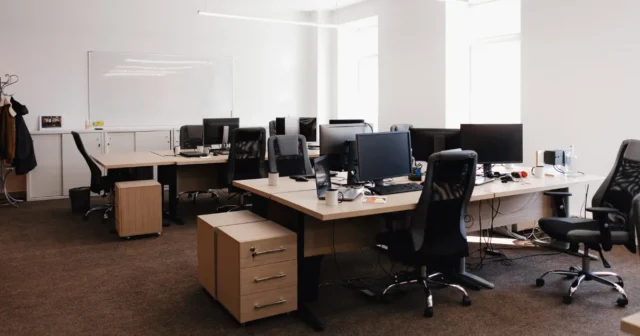
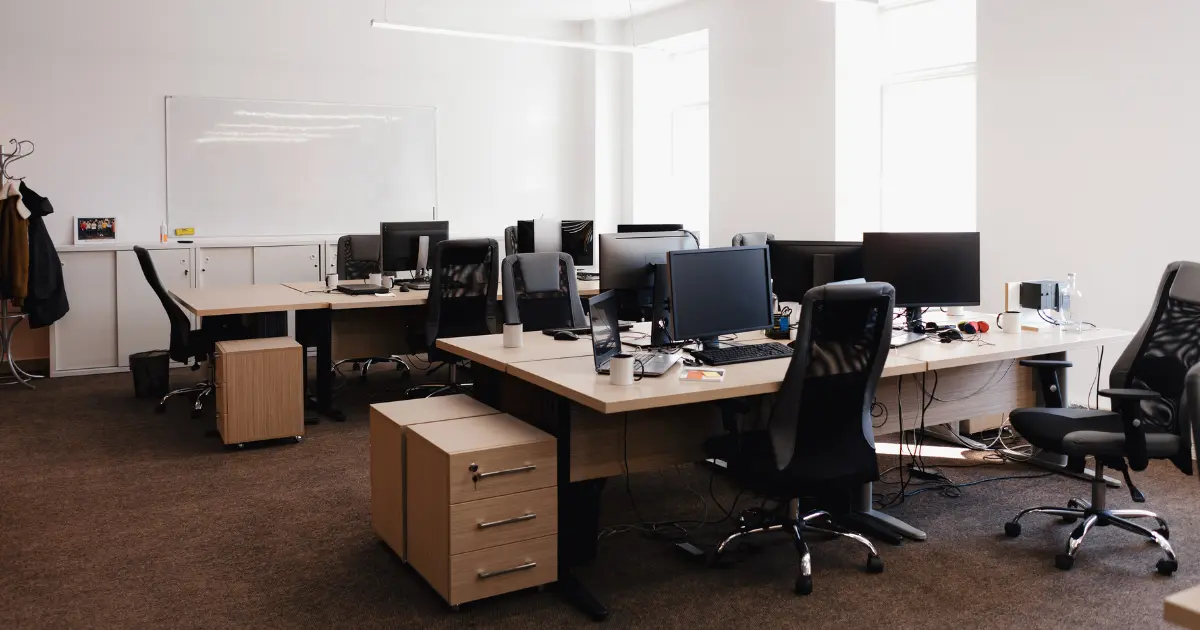
The open-plan office is another of the most widespread main types of office in contemporary settings. In this system, workstations share a large space with no fixed partitions, which makes visibility, circulation and communication between colleagues easier.
The open-space model became popular for its ability to encourage collaboration and optimise the available floor area. It also tends to convey a more dynamic and less rigid image of the company. In some cases, it also simplifies adapting the space when teams or operational needs change.
Most common advantages of an open-plan office
Its most frequently cited benefits include:
- Easier communication.
- Better use of space.
- A sense of openness and spaciousness.
- More flexibility in the layout.
- Encouragement of teamwork.
Even so, this format needs careful planning to avoid noise, distractions and a lack of privacy.
Hybrid office
Among the main types of office, the hybrid office has gained prominence in recent years. It is a model designed to combine on-site and remote work, adapting the space to variable occupancy and new patterns of use.
Rather than always assigning a fixed desk to each person, the hybrid office usually includes flexible zones, shared areas, meeting rooms equipped for remote connections and spaces designed for valuable in-person gatherings. This approach suits companies that do not need their entire workforce in the office every day.
The key to this type of office lies in its ability to adapt. It works neither like a traditional office nor like a fully open one, but as a more modular and dynamic environment.
Office with combined private rooms
Another of the main types of office is the mixed model, or office with combined private rooms. In this case, the office integrates open areas with a number of closed offices, meeting rooms and support spaces. It is a very popular option among companies that need a balance between collaboration and privacy.
This system makes it possible to enjoy the advantages of open space without giving up secluded environments for management, confidential meetings or tasks that demand greater concentration. It also helps to segment the uses of the space more clearly and to adapt each zone to a specific function.
When this model tends to work best
The combined office is usually useful when the aim is to:
- Maintain privacy in certain areas.
- Encourage collaboration in other zones.
- Offer a variety of working environments.
- Adapt to different profiles within the team.
Thanks to its versatility, it is one of the most balanced solutions for many companies today.
Flexible office
The flexible office is one of the main types of office that best responds to changing organisations. This model is characterised by an adaptable layout, with mobile furniture, multi-purpose zones and spaces that can be transformed according to the needs of the moment.
Its main advantage is that it avoids overly rigid structures. The same area can be used for individual work, meetings, group sessions or temporary activities. This is particularly useful for growing companies, creative teams or businesses whose operations change frequently.
Flexibility is not just about moving furniture around. It also means designing the space so that it can evolve without losing functionality or coherence.
Coworking office
Although it is sometimes seen as a separate category, coworking can also be counted among the main types of office. It is a space shared by professionals, small companies or freelancers who use communal areas and, in some cases, private desks or offices.
This model stands out for its flexibility of use and for encouraging interaction between different profiles. It is common among entrepreneurs, self-employed professionals, small teams or businesses that do not need a conventional office of their own. It also usually offers integrated services that simplify the management of the space.
Beyond renting a desk, coworking represents a different way of understanding the working environment, with a more open, collaborative and adaptable approach.
Departmental office
Among the main types of office, we also find offices organised by department. In this system, the space is distributed according to the company’s functional areas, grouping teams by activity, such as administration, sales, design, management or customer service.
This organisation facilitates internal coordination within each area and helps to structure workflows more effectively. It also makes it possible to adapt the environment to specific needs. For example, a creative department does not require the same space as a team focused on calls or administrative tasks.
This model can be combined with different physical formats, whether open, closed or mixed. What matters is that the layout responds to the operational logic of the business.
Executive office
The executive office is one of the main types of office associated with management or representational functions. It is usually a more private space, with a carefully considered image, designed for meetings, decision-making and receiving important visitors.
It does not necessarily imply luxury, but it does involve greater attention to privacy, comfort and professional presence. In small companies, it may be a single private office. In larger structures, it is usually integrated into a combined system alongside other operational areas.
The executive office serves a dual purpose: facilitating the work of management and reinforcing the perception of authority, order and professionalism within the organisation.
Satellite office
The satellite office also appears among the main types of office in companies with a distributed presence or decentralised working models. It is a secondary site, usually smaller than the main one, located in another area to bring work closer to certain teams, clients or markets.
This type of office helps to reduce commuting, improve geographical coverage and provide support points closer to staff. In some cases, it also forms part of a hybrid strategy to avoid all activity depending on a single headquarters.
Common characteristics of a satellite office
It usually stands out for aspects such as:
- Smaller size than the main site.
- Strategic location.
- Partial or shared use.
- A functional, practical focus.
- Support for distributed working models.
It is an increasingly attractive option for companies seeking territorial flexibility.
Home office
The home office is now one of the main types of office owing to the weight that remote work has acquired. It consists of adapting an area of the home to carry out professional activity with a degree of stability, functionality and comfort.
Although it is not always perceived as an office in the traditional sense, its design has a major influence on productivity and on the quality of daily work. A well-planned home office should offer ergonomics, good lighting, order and a reasonable separation between personal life and work.
This model is especially common among freelancers, remote workers and companies that have adopted remote or hybrid schemes.
| Type of office | Main characteristics | Advantages | Disadvantages | Best suited to |
|---|---|---|---|---|
| Closed office | Rooms separated by walls or independent offices | Privacy, concentration, confidentiality | Less interaction between teams | Law firms, consultancies, management |
| Open-plan office (open space) | Shared space with no fixed partitions | Fast communication, collaboration, space savings | Noise and distractions | Start-ups, creative companies |
| Hybrid office | Combines on-site and remote work | Flexibility, space optimisation | Requires sound technological organisation | Modern companies with remote working |
| Combined office | Mixes open space with closed offices | Balance between privacy and collaboration | Greater design complexity | Medium-sized and large companies |
| Flexible office | Adaptable spaces and mobile furniture | High adaptability | Can become disorderly if poorly managed | Creative teams and dynamic companies |
| Coworking | Space shared between different professionals | Networking, flexibility, services included | Weaker corporate identity | Freelancers and start-ups |
| Departmental office | Layout based on work areas | Clear team organisation | Can create silos between departments | Structured companies |
| Executive office | Private offices for management | Prestige and privacy | Limited use of space | Management and key meetings |
| Satellite office | Secondary company site | Proximity to clients or teams | Cost of multiple locations | Companies with a regional presence |
| Home office | Workspace at home | Comfort, no commuting | Hard to separate personal and working life | Remote workers and freelancers |
How to choose between the main types of office
Choosing between the main types of office does not depend solely on the size of the company. The activity, the working culture, the number of people, the need for meetings, the degree of confidentiality and how often the team uses the space all play a part.
A creative company may work better in a flexible, open environment, whereas a law firm will probably need greater privacy. Likewise, an organisation with hybrid working will have to think about variable occupancy, technology and multi-purpose spaces.
Before deciding, it is worth analysing which tasks are carried out, how the teams interact and what experience you want to offer both staff and clients or visitors.
In summary: what are the main types of office
The main types of office include the closed office, the open-plan office, the hybrid office, the combined office, the flexible office, coworking, the departmental office, the executive office, the satellite office and the home office. Each one responds to different needs in terms of organisation, privacy, collaboration and use of space.
There is no single ideal model for every company. The best office is the one that adapts to the real activity of the business and helps people work better. That is why knowing the different typologies is the first step towards designing a more functional, coherent and efficient working environment.
Office design can have a direct influence on productivity by improving the organisation of the space, reducing distractions and facilitating collaboration between teams. Factors such as lighting, ergonomics, the arrangement of workstations and the availability of meeting rooms affect daily performance and staff wellbeing. Many organisations opt for mixed models because different tasks require different environments. Open areas favour collaboration, while closed rooms allow people to concentrate or hold private meetings. This combination makes it possible to adapt the space to different ways of working. Architecture makes it possible to organise space strategically to improve the working experience. Through the layout, the materials, the lighting and the relationship between open and private zones, architectural design can create working environments that are more efficient, more comfortable and better aligned with the company’s culture.Frequently Asked Questions
How does office design influence team productivity?
Why do many companies combine different types of office in a single space?
What role does architecture play in planning modern offices?